

Whether BHRT is covered by insurance in Texas depends on your plan, the treatment, and how the claim is processed. Some plans may cover medically indicated visits, lab work, or FDA-approved hormone prescriptions. Compounded preparations are typically not covered, so coverage for evaluation and monitoring may differ from coverage for the medication.
Considering perimenopause or menopause care can be difficult when it is unclear which expenses insurance may cover. Plans may handle clinical visits and testing differently from prescription medication, particularly compounded treatments.
This article explains how plan rules, medical-necessity criteria, and prior authorization can affect coverage, and why menopause benefits vary in Texas. It also outlines what to review as you consider BHRT and related care.
Key Takeaways
- Coverage may differ for consultations, office visits, lab work, and hormone medication, so each part of care can be handled separately by your plan.
- Medical necessity documentation and prior authorization requirements can affect whether a treatment is approved.
- Learn why compounded preparations and FDA-approved hormone prescriptions may receive different coverage.
- If a claim is denied, the U.S. Department of Labor says most health-plan members must file an internal appeal within 180 days of receiving the denial notice.
Coverage for consultations, lab work, and office visits
Depending on your plan, insurance may cover some visits to evaluate symptoms or monitor hormone therapy. A consultation about menopause symptoms is separate from coverage for medication. Your benefits determine whether a visit is covered and whether a copayment, coinsurance, or deductible applies.
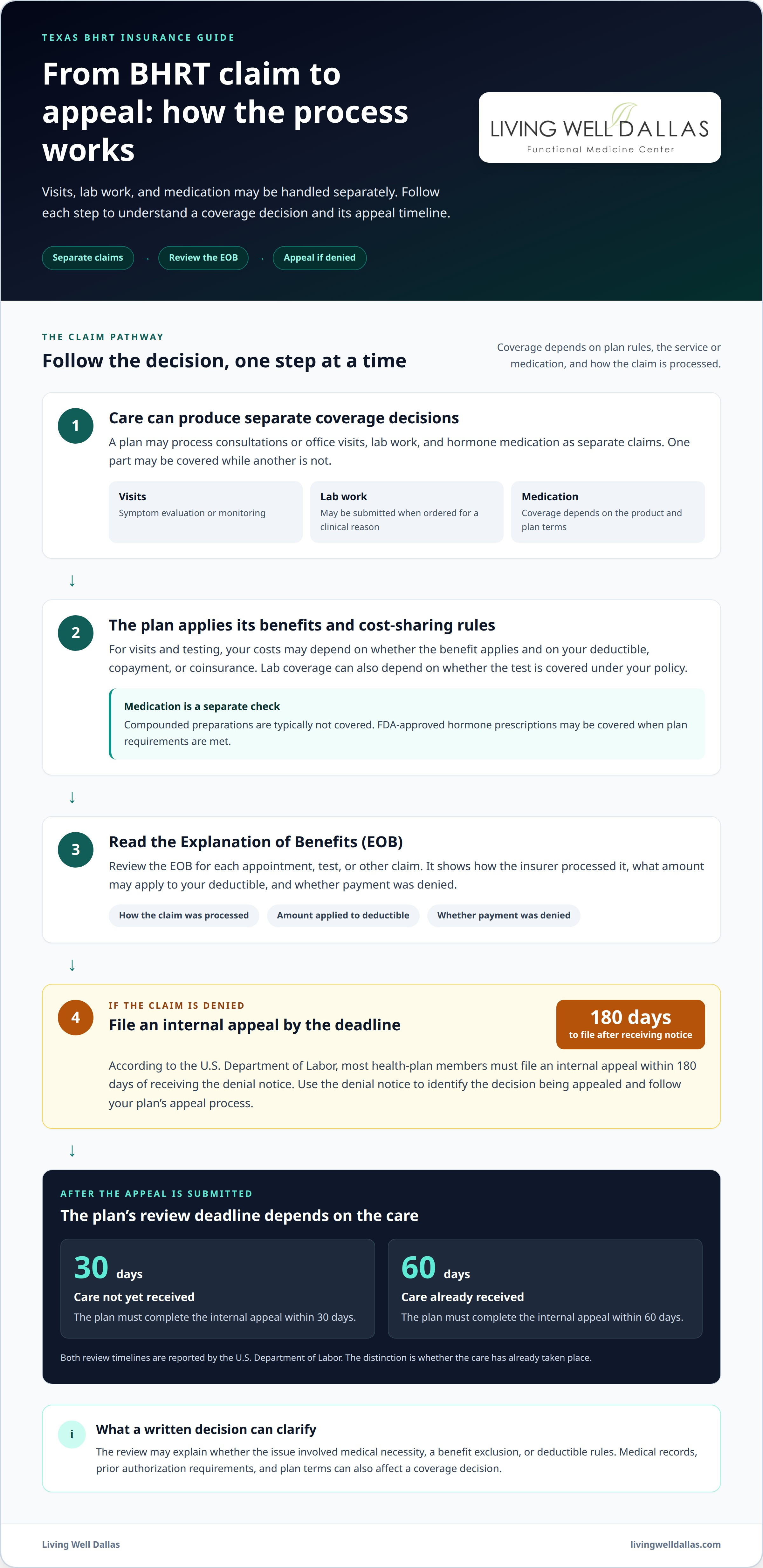
Lab work ordered for a clinical reason may be submitted to insurance, but your costs depend on plan rules, including your deductible and whether the test is covered. Hormone testing as part of an evaluation may be treated differently from testing your policy excludes. Visits and lab work may also be processed as separate claims, so one may be covered while the other is not.
Review the explanation of benefits for each claim. It shows how the insurer processed the appointment or testing, what portion may apply to your deductible, and whether it denied payment. If a claim is denied, the appeal deadline matters: according to the U.S. Department of Labor, patients in most health plans must file an internal appeal within 180 days of receiving notice of a denial.
The appeal review also has a time limit. According to the U.S. Department of Labor, a health plan must complete an internal appeal within 30 days for care you have not yet received. For care you have already received, the plan must complete the internal appeal within 60 days, according to the U.S. Department of Labor. These timelines distinguish a request for planned care from a claim for a completed appointment or test. Use the denial notice to identify the decision being appealed, then submit the appeal through your plan’s process before its deadline. A written decision can clarify whether the issue involved medical necessity, a benefit exclusion, or deductible rules.
Medical necessity and insurance approval
Coverage depends on your plan’s rules and whether the requested treatment meets its medical-necessity criteria. Formulation matters too, especially when a plan distinguishes FDA-approved medications from compounded preparations.
Medical Necessity and Plan Requirements
Medical necessity refers to an insurer’s assessment of whether care is appropriate for a documented condition. For hormone therapy, a plan may consider symptoms, diagnosis, treatment history, and the prescribed medication. Clinical records can explain the reasons for a proposed treatment plan. Because insurers apply their own benefit terms, approval for one hormone or service does not establish coverage for another.
Compounded Medication Coverage
Compounded BHRT is prepared for an individual rather than supplied as an FDA-approved commercial drug. Compounded preparations are not FDA-approved in the same manner as commercial pharmaceuticals, and insurance typically does not cover them. Coverage therefore depends in part on whether the prescribed product is compounded or an approved medication. The American College of Obstetricians and Gynecologists recommends FDA-approved menopausal hormone therapies over compounded products when approved options are available.
Medicare and Medicaid Coverage
Medicare coverage depends on the part of Medicare and the prescription plan’s criteria. Part D may cover prescribed outpatient hormone medications when plan requirements are met, while Original Medicare Part B generally does not cover medicines patients take themselves, subject to exceptions. Medicare Advantage coverage also depends on the plan. Medicaid coverage for hormone therapy varies by state, so Texas beneficiaries must consider the rules of their specific coverage.
Texas Insurance Coverage Rules
Texas law does not establish a blanket BHRT coverage requirement in the available legislative facts. Texas H.B. 3814 proposed requiring health benefit plans with prescription drug benefits to cover prescription drugs for perimenopause or menopause, including hormone replacement therapy. The Texas Legislature’s introduced text describes a proposal, not proof that every plan must cover every BHRT treatment. That distinction matters: a plan’s covered-drug list, medical-necessity criteria, and exclusions still shape approval. For patients, the medication and policy terms remain central factors in determining coverage.
Prior authorization and in-network care
Plan rules can affect coverage for a prescribed hormone therapy. Prior authorization, network status, and a medication’s formulary listing are separate factors.
Prior Authorization Requirements
Prior authorization is an insurer’s review of a treatment before deciding whether the plan will cover it. A plan may require authorization, supporting medical records, or a trial of alternative drugs before approving hormone therapy. For medication prescribed for hot flashes, the insurer’s criteria may shape which option is considered. Authorization does not guarantee payment, so the plan’s final decision and coverage terms matter.
Provider Networks and Formularies
A provider network is the group of clinicians and facilities contracted with a health plan. A formulary lists the prescription drugs covered by the plan and any restrictions. These are separate considerations: an in-network consultation does not mean every prescribed hormone is covered. A plan may cover some oral or transdermal options, sometimes with a generic requirement, while treating pellets differently. Checking each benefit can clarify a coverage decision.
In-Network Insurance Providers
In-network care means the provider participates in the plan’s contracted network. This can affect how an appointment is processed, but cost-sharing may still apply. A patient may owe a copayment, coinsurance, or deductible for an in-network menopause evaluation. Prescription coverage is a separate question, particularly for pellets, which most commercial plans do not cover themselves.
To review coverage, consider the service and medication separately: find out whether the provider is in network, whether the drug is on the formulary, and whether prior authorization is required. If the plan requires supporting records or a trial of another drug, those rules may affect approval. A covered consultation does not necessarily mean the hormone treatment is covered.
Insurance coverage for menopause treatment
Menopause care may include evaluation visits, lab work, and prescription treatment, each processed separately by an insurance plan. Coverage for menopause care does not automatically mean every bioidentical hormone treatment or formulation is covered.
Bioidentical hormone replacement therapy (BHRT) uses bioidentical hormones to address symptoms associated with perimenopause or menopause. Treatment may involve FDA-approved medications, such as certain estradiol and micronized progesterone prescriptions, or compounded preparations. Forms may include oral medication, patches, or gels.
Your plan’s benefits and medication rules determine what may be covered. Some oral or transdermal hormone prescriptions may be covered, sometimes with a generic requirement. Compounded BHRT medication is typically not covered, and most commercial plans do not cover BioTE pellets themselves. A clinician’s recommendation alone does not make every formulation a covered benefit.
Texas menopause coverage varies by plan and location. As of May 2025, Texas was among 13 states that had proposed menopause-care legislation. The Texas Legislature’s introduced text for H.B. 3814 proposed requiring health benefit plans with prescription drug benefits to cover a prescription drug to treat perimenopause or menopause. That proposal is distinct from a blanket guarantee that every BHRT product is covered.
To understand a treatment decision, separate the appointment, testing, and medication in the plan’s benefits. Then consider the prescribed product, whether it is FDA-approved or compounded, and any formulary or medical-necessity criteria. Those details help explain why one menopause treatment may receive coverage while another does not. For support exploring perimenopause, menopause, and BHRT care, consider a clinical consultation focused on your symptoms and treatment options.
Living Well Dallas
If you’re considering menopause care or BHRT, Living Well Dallas offers a Functional Medicine Consultation to discuss symptoms, health history, and treatment questions in a broader clinical context. The practice also provides Perimenopause & Menopause care, Bioidentical Hormone Replacement Therapy, and Autoimmune Support.
This can be useful when you want to understand how your concerns relate to possible treatment approaches, rather than focusing on a prescription alone. Bring your insurance plan’s coverage questions into the conversation so your care decisions account for both your clinical needs and the plan’s requirements.
Contact Living Well Dallas to discuss your care.
Take the Next Step With Clarity
Knowing whether BHRT is covered by insurance in Texas can help you plan, but care should also reflect your symptoms, health history, and goals. Before a consultation, note what you want help addressing and which treatment or coverage questions you still have. This gives the discussion a practical starting point.
Living Well Dallas offers Functional Medicine Consultations, Perimenopause & Menopause care, and Bioidentical Hormone Replacement Therapy. These services provide space to discuss your concerns and potential care options as part of an individualized approach. Your clinical needs shape that conversation, while your insurance plan’s terms remain relevant to medication and lab coverage.
If you’re ready to explore your questions in a supportive setting, contact Living Well Dallas. A thoughtful next conversation can help you move forward with greater confidence.
Frequently Asked Questions
Is Bioidentical Hormone Therapy Covered by Insurance?
Sometimes. Whether BHRT is covered by insurance in Texas depends on the medication and your plan’s terms, not simply the “bioidentical” label. A plan may treat an FDA-approved estradiol prescription differently from a compounded preparation, and may process evaluation separately from medication. Review the formulary and exclusions to see how your specific prescription is classified.
What Are the Factors Influencing Insurance Coverage for BHRT?
Key factors include the medical indication, prescribed formulation, provider network status, and the plan’s drug list. Prior authorization or a required trial of another medication may also apply. For example, a plan may cover an in-network evaluation but exclude a compounded product or prefer a generic. Medication coverage may differ from coverage for appointments or testing.
Are There Options for Managing Out-of-Pocket Expenses?
An HSA or FSA may be an option when account rules allow the expense. The IRS says prescribed medicines and drugs can count as medical expenses. HSA balances carry forward each year, while FSAs often have an employer-set spending deadline. Keep receipts and review your account terms before using funds for a BHRT-related expense.
Do You Need a Prescription for BHRT?
Yes. Prescription hormone medications require a clinician’s prescription; BHRT is not an over-the-counter treatment. The prescriber considers symptoms, health history, and the treatment under consideration. For a compounded preparation, the prescription identifies the formulation. Having a prescription documents the treatment, but does not mean insurance covers the medication.
How Much Does Hormone Replacement Therapy Cost?
The total depends on the treatment form, prescribed product, consultation and monitoring needs, and how insurance processes each claim. Oral medication, patches, gels, and pellets involve different treatment and dispensing arrangements, so costs vary. Deductibles, copayments, and other plan terms can affect out-of-pocket expenses. Consider the expected parts of care, not just the medication.
Do Texas Insurance Plans Cover FDA-Approved Bioidentical Hormones Such as Estradiol or Micronized Progesterone?
Some Texas plans may cover certain FDA-approved forms of estradiol or micronized progesterone when the prescription meets plan requirements and has a medical indication. Coverage can vary by product, generic preference, and formulary restrictions. Coverage for one form does not establish coverage for another, even when both address menopause symptoms. The specific medication and formulation matter under the plan’s drug benefit.