
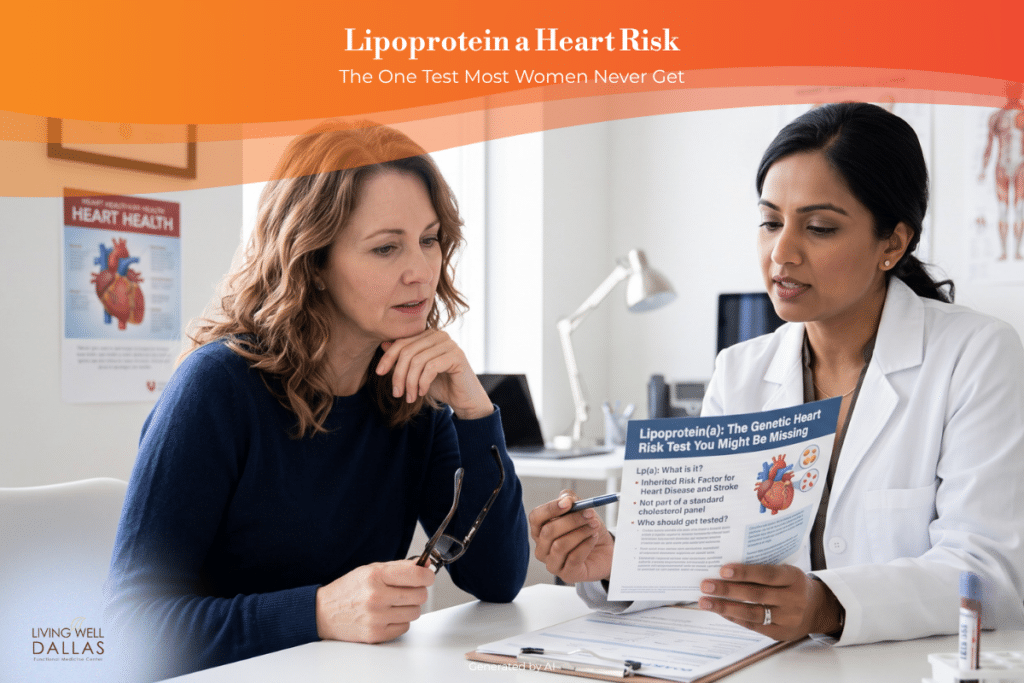
You have done everything right. Clean diet, regular movement, cholesterol that looks fine on paper. And still, heart disease runs in your family and nobody can tell you why your risk feels higher than the numbers suggest. There is a good chance no one ever tested your lipoprotein a heart risk.
Here is what almost no one explains. There is an inherited cholesterol particle called lipoprotein(a), written Lp(a). More than 90% of your level comes from your genes. Diet and exercise barely move it.
I have had this conversation more times than I can count. A woman with a scary family history, doing all the right things, still anxious about her heart. So I order the one test her other doctors skipped. And often, that test explains what nothing else could.
Why Lipoprotein a Heart Risk Climbs After Menopause
Let me connect the dots nobody connected for you. Lp(a) is not static. It rises during the menopause transition, running about 27% higher after menopause. And that jump lands at the exact moment women’s heart risk accelerates.
Translation: your inherited risk and your menopause timing stack on top of each other. A 2026 review in JACC: Advances covered lipoprotein(a) and women’s heart health in detail. The lipoprotein a heart risk story is finally getting the attention it deserves.
What This Looks Like in Practice
Women come to me blindsided. They did not know a single blood test could reveal this. Because most doctors never offer it. The American Heart Association has pushed for wider Lp(a) awareness, yet the test still slips through the cracks in routine care.
What You Can Actually Do About Lipoprotein a Heart Risk
Here is the good news. You only need to test Lp(a) once in your lifetime. One draw, one number, lifelong information. Yet most doctors never order it at all.
Estrogen changes the picture too. Estradiol lowers Lp(a). Oral estradiol lowers it more than the transdermal form, and Lp(a) runs about 12% lower during hormone therapy. So your hormone choices interact with this inherited risk.
That does not mean hormones are a treatment for high Lp(a). It means the full picture matters. At Living Well Dallas Functional Medicine Center, I test Lp(a) once, factor it into your heart plan, and adjust everything else we can control around it.
Key Takeaways
- Lipoprotein a heart risk comes mostly from your genes; you inherit more than 90% of your Lp(a) level.
- Diet and exercise barely change Lp(a), so a normal lifestyle does not rule out high risk.
- Lp(a) rises about 27% after menopause, right when women’s heart risk accelerates.
- Estradiol lowers Lp(a), with oral lowering more than transdermal, and levels run about 12% lower on hormone therapy.
- You only need to test Lp(a) once in a lifetime, yet most women never get the test.
Frequently Asked Questions
What is lipoprotein(a)? It is an inherited cholesterol particle, written Lp(a). More than 90% of your level comes from your genes, so lifestyle barely changes it.
Why does lipoprotein a heart risk matter for women? Lp(a) rises about 27% after menopause, exactly when heart risk climbs. So it can explain elevated risk that standard cholesterol tests miss.
Testing for Lp(a)
How often do I need the test? Once in your lifetime. Because genetics set your level, a single measurement tells you what you need to know.
Why has no one tested me before? Most doctors simply never order it. The test is not yet routine, even though awareness is growing.
Hormones and Lp(a)
Does hormone therapy affect Lp(a)? Yes. Estradiol lowers Lp(a), and levels run about 12% lower during hormone therapy. Oral estradiol lowers it more than the transdermal form.
Can I lower Lp(a) with diet? Barely. Since you inherit more than 90% of your level, diet and exercise move it very little. That is why knowing your number and managing overall heart risk matters more.
Dr. Betty’s Bottom Line
I am tired of watching women get blindsided by heart risk that a single test could have flagged years earlier. Lipoprotein a heart risk is inherited, it is measurable, and it is largely invisible on a standard panel. That combination is dangerous.
Here is what I want you to do. Ask for the Lp(a) test once. Know your number. Because if it runs high, we manage every other risk factor harder and we factor it into your hormone decisions. And if it runs normal, you get real peace of mind instead of vague worry.
So do not wait for symptoms. One test tells you something you will carry for life. Your genes are not your destiny, but they are information worth having.
In-person care at Living Well Dallas Functional Medicine Center is available for patients in the Dallas area, covering Lp(a) testing, a full heart risk review, and a plan that accounts for both your genetics and your menopause status. Start at livingwelldallas.com.
Source: JACC: Advances, 2026 review of lipoprotein(a) and women’s heart health, https://www.jacc.org/doi/10.1016/j.jacadv.2026.102744 ; American Heart Association, https://www.ahajournals.org.