
Women come to me convinced their body is breaking down. The knees complain on every staircase. Shoulders stiffen overnight, hands feel swollen and clumsy before coffee, and no injury explains a bit of it. This is menopause joint pain, and I see it in my practice almost every week.
Here is what usually happens next. Their doctor orders a test for rheumatoid arthritis, finds nothing, and sends them home. So they decide it must be age, or worse, that it is all in their head. It is neither.
Because the real driver is hormonal, and the research finally has a name for it. Researchers now call this cluster of aches, stiffness, and muscle loss the musculoskeletal syndrome of menopause. More than 70% of women feel it. And nobody is connecting those dots for them.
What Menopause Joint Pain Actually Is
Menopause joint pain is not one problem. It is several, all triggered by the same thing: falling estrogen. Estrogen does quiet protective work across the whole musculoskeletal system. It calms inflammation. It supports cartilage and the soft tissue around every joint. And it helps you hold on to muscle and bone.
So when estrogen drops, that protection drops with it. Inflammation climbs. Cartilage thins. Muscle gets harder to keep, and the joints that used to feel silent start to ache.
Here is what that means for you: the pain is real, it is measurable, and it has a mechanism. In a 2024 paper in the journal Climacteric, researchers grouped these changes together for the first time and estimated that more than half of women in the menopause transition report joint pain. Translation: you are not imagining it, and you are far from alone. The Menopause Society now lists musculoskeletal symptoms among the common features of this stage of life.
Why Doctors Keep Missing Menopause Joint Pain
Because the symptoms scatter over time, menopause joint pain rarely gets pinned on hormones. A woman shows up with a sore shoulder. Six months later, stiff hands. A year after that, a knee that grinds. Each visit gets its own explanation. Nobody steps back and asks the obvious question: what changed in her body during those two years?
The answer is estrogen. In fact, the timing is the tell. Frozen shoulder, for one, spikes sharply in women between 40 and 60, far more than in men the same age. That is not a coincidence. That is estrogen.
What This Looks Like in Practice
Women come to me after years of this. One told me she had seen four specialists for four separate joints, and not one of them mentioned menopause. So we ran a full hormone workup. We looked at her estrogen, her inflammation markers, her muscle mass, and her vitamin D. And the picture came together fast.
Here is what that means: treating each joint alone was never going to work. The root cause sat upstream, in her hormones, and that is where we started.
What You Can Do About Menopause Joint Pain
So what actually helps menopause joint pain? Start with the root cause, not the symptom.
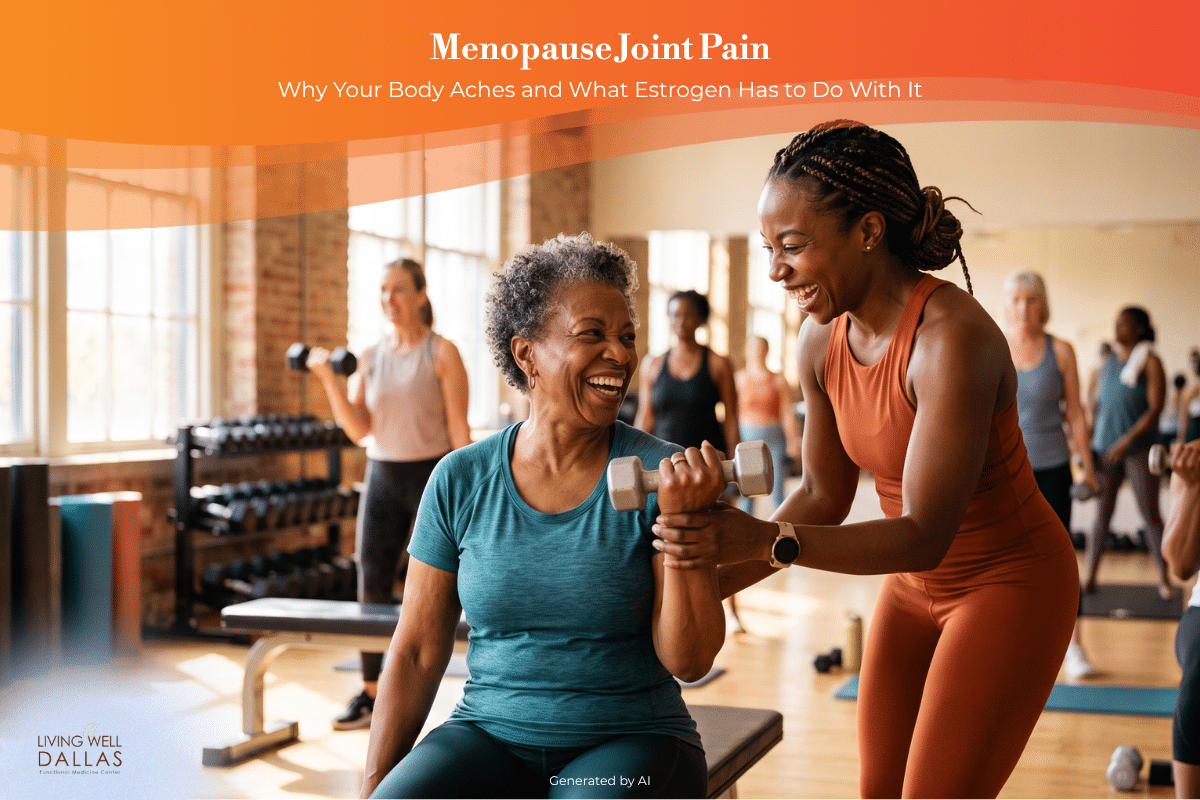
Muscle is your first line of defense. Estrogen loss speeds up muscle breakdown, so you have to fight back with resistance training. Lifting heavy, two or three times a week, protects your joints by building the tissue that supports them. Protein matters too. Most women I see eat far too little of it.
Inflammation is the second target. An anti-inflammation diet, steady blood sugar, and enough omega-3 fats all lower the load your joints carry. On top of that, vitamin D and solid sleep do more for joint pain than most women expect.
And then there is hormone therapy. For many women, replacing estrogen directly addresses the driver of the pain. That is a conversation to have with a clinician who understands the research, not the outdated fears. At Living Well Dallas Functional Medicine Center, we build that plan around your labs, not a guess.
Key Takeaways
- Menopause joint pain is real and driven by falling estrogen, not aging or imagination.
- More than 70% of women feel musculoskeletal symptoms during the transition, and over half report joint pain.
- Estrogen calms inflammation, protects cartilage, and preserves muscle. When it drops, joints suffer.
- Resistance training, protein, and lower inflammation form the foundation of relief.
- Hormone therapy, guided by lab testing, addresses the root cause for many women.
Frequently Asked Questions
Is menopause joint pain permanent? No. So much of it responds to treatment. Once you address estrogen, muscle, and inflammation, the aches often ease. That said, ignored joint pain can progress to osteoarthritis, so early action matters.
Can perimenopause cause joint pain before periods stop? Yes. In fact, joint pain often shows up in perimenopause, years before your last period, because estrogen swings wildly during that window. Many women feel it first in the hands and shoulders.
Menopause Joint Pain and Treatment
Does hormone therapy help menopause joint pain? For many women, yes. Estrogen therapy directly targets the hormonal driver behind the aches. Specifically, it lowers inflammation and helps protect cartilage and muscle. A clinician should tailor it to your history and labs.
What supplements help with joint pain in menopause? Vitamin D, omega-3 fats, and enough protein top the list. So does magnesium for many women. These support the tissue and calm the inflammation that estrogen loss unleashes.
When to See a Doctor
When should I worry about joint pain? See a doctor if a joint is hot, red, badly swollen, or if pain wakes you at night. Those signs point to something beyond hormones. Otherwise, widespread aching that tracks with other menopause symptoms usually traces back to estrogen.
Will exercise make joint pain worse? Usually the opposite. Strength training builds the muscle that stabilizes your joints, so it protects them over time. Start gradually, and let a professional guide your form if you are new to lifting.
Dr. Betty’s Bottom Line
I have had this conversation more times than I can count. A woman sits across from me, exhausted from being told her aching body is just getting older. Nobody checked her hormones. Nobody connected the sore shoulder to the stiff hands to the knee that gave out. And nobody told her that estrogen was the thread running through all of it.
Here is what I want you to hear. Menopause joint pain has a cause, and that cause has treatments. So we do not chase each joint one at a time. Instead, we find the root, test what is actually happening in your body, and build a plan around resistance training, targeted nutrition, and, when it fits, hormone therapy.
You do not have to accept an aching body as the price of getting older. That is easy to say when you are not the one living it, so I will say it plainly instead: bring me your labs and your symptoms, and let us find the real reason.
Ready to find the root cause of your joint pain? In-person care at Living Well Dallas Functional Medicine Center is available for patients in the Dallas area, covering hormone testing, muscle and joint health, and a plan built around your labs.
Source: Wright VJ, Schwartzman JD, Itinoche R, Wittstein J. The musculoskeletal syndrome of menopause. Climacteric. 2024;27(5):466-472. doi:10.1080/13697137.2024.2380363.