

A stool study can assess more than signs of infection. If you’re searching for comprehensive stool analysis near me in Dallas, a detailed stool panel may evaluate digestion and nutrient absorption, gut microbes, yeast, parasites, pathogens, blood, and other stool markers. The exact findings depend on the test.
When digestive symptoms are difficult to explain, it’s understandable to want more than a single result. A detailed analysis can bring several types of information together, but results are most useful when considered alongside your symptoms and health history, not as a stand-alone diagnosis.
Learn what a comprehensive stool study may assess, how sample collection works, and how to understand the findings. We’ll cover digestive function and absorption, gut bacteria and other organisms, and how results may inform a thoughtful next step.
Key Takeaways
- Learn how collection and shipping instructions can affect whether a stool sample is suitable for analysis.
- See how digestive markers can offer clues about pancreatic enzyme production and nutrient absorption.
- Understand what testing may reveal about gut microbes, yeast, parasites, and selected pathogens.
- Explore how to interpret findings as part of a broader picture of gut health and decide what to discuss next.
What is Complete Stool Study?
A comprehensive stool study examines a sample for digestive markers and signs of intestinal microbes, parasites, pathogens, blood, or other abnormalities. Careful collection matters because the laboratory needs a properly handled sample to analyze.
Sample Preparation and Collection
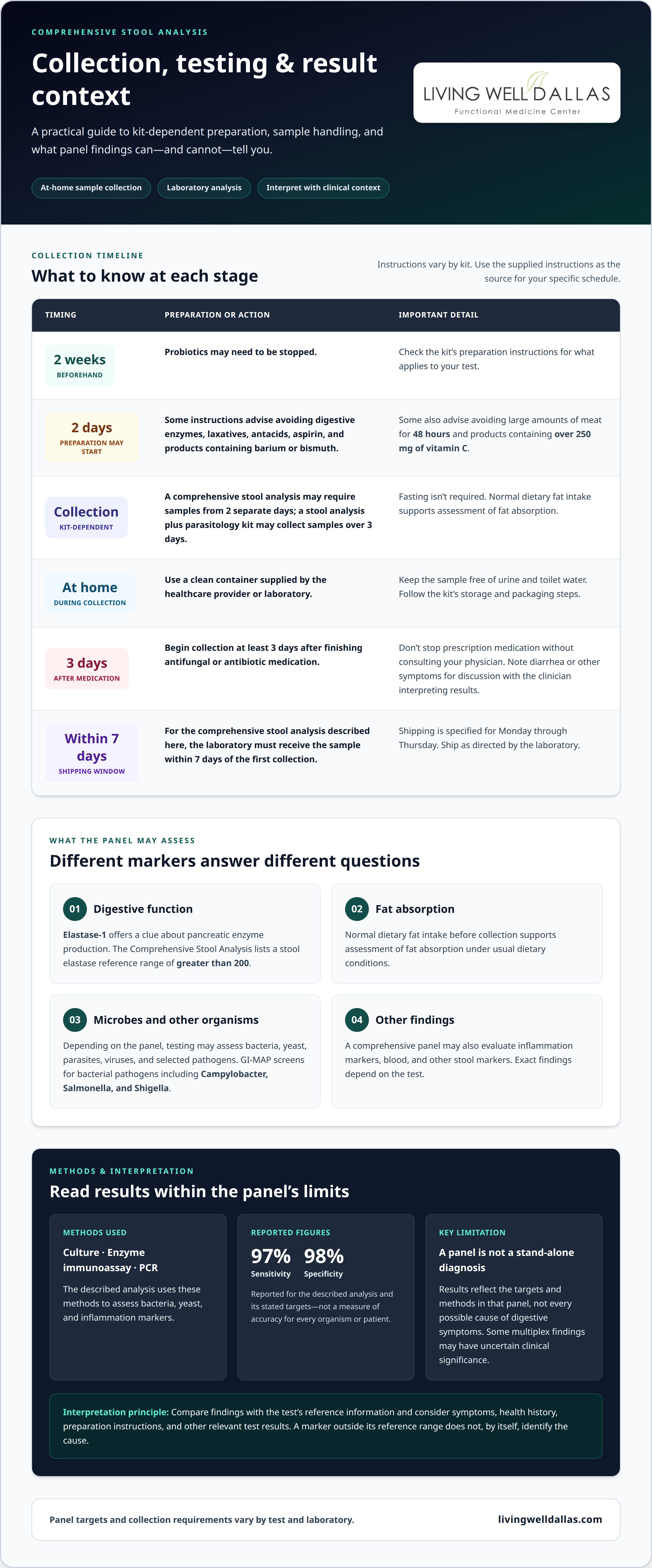
Follow the kit’s instructions, as collection schedules vary. A comprehensive stool analysis may require samples from two separate days, while a stool analysis plus parasitology kit may collect samples over three days. Preparation may start two days before collection. Instructions may include avoiding digestive enzymes, laxatives, antacids, aspirin, and products containing barium or bismuth during preparation and collection. Probiotics may need to be stopped two weeks beforehand. Don’t stop prescription medication without consulting your physician.
Some instructions also advise avoiding large amounts of meat for 48 hours and products containing over 250 mg of vitamin C. Fasting isn’t required, and normal dietary fat intake supports assessment of fat absorption.
At-Home Collection and Shipping
Collection usually takes place at home, using a clean container supplied by a healthcare provider or laboratory. Keep the sample free of urine and toilet water to avoid contamination that could affect results. Follow the kit’s storage and packaging steps, then ship it as directed by the laboratory.
For the comprehensive stool analysis described here, the laboratory must receive the sample within seven days of the first collection. Shipping is specified for Monday through Thursday. Begin collection at least three days after finishing antifungal or antibiotic medication. If diarrhea or another symptom occurs, note it for discussion with the clinician interpreting the results.
Laboratory Analysis
Laboratories use different methods to detect organisms and markers. The comprehensive stool analysis described here uses culture, enzyme immunoassay, and PCR to assess bacteria, yeast, and inflammation markers. Results reflect the targets and methods in that panel, not every possible cause of digestive symptoms.
Multiplex testing may detect findings that conventional testing does not. The Centers for Medicare & Medicaid Services notes that the clinical significance of some such results may be uncertain. Interpret findings alongside symptoms and medical history.
Test Accuracy Compared With Standard Tests
No single accuracy figure makes a comprehensive panel directly comparable with every standard stool test. Reported figures for the described analysis include 97% sensitivity and 98% specificity for its stated targets; these values don’t establish accuracy for every organism or patient. A conventional culture, occult blood test, or parasite test answers a narrower question.
In Dallas, direct-access laboratories may offer testing without a doctor’s referral, depending on the panel and ordering process. Costs vary by test panel, laboratory, and insurance benefits. Without insurance, the laboratory provides a cost after a quote request. Coverage and billing codes depend on the tests ordered and the plan, so confirm benefits and coding with the insurer before testing.
Digestive function and nutrient absorption
Stool testing can assess digestive function through markers found in a sample. One example is elastase-1, associated with pancreatic enzyme production.
Digestive Function Assessment
Elastase-1 offers a clue about pancreatic enzyme production, a part of digestive function. The Comprehensive Stool Analysis lists a stool elastase reference range greater than 200. Compare the reported result with that range, then interpret it alongside symptoms and other test findings. A stool marker is one piece of diagnostic information, not a complete explanation for every digestive concern.
That context matters when symptoms include diarrhea or changes in stool consistency. A marker outside its reference range does not, by itself, identify the cause. A clinician can consider the finding alongside your history, current symptoms, and other relevant tests to interpret what it means for you.
Nutrient Absorption Markers
Absorption assessment considers whether digestion appears to support the body’s use of nutrients. Collection instructions advise eating normal amounts of dietary fat before providing a sample. This helps the laboratory assess fat absorption under usual dietary conditions, rather than after an unusual restriction.
Results should be read in relation to the preparation instructions and the test’s listed markers. For example, the elastase-1 result relates to pancreatic enzyme production, while the fat-related assessment concerns absorption. Neither finding measures every nutrient or explains every possible reason for digestive symptoms. Share changes in diet or symptoms with the clinician interpreting your results.
For a clearer view, connect stool findings with your food patterns, symptoms, and other relevant testing. A nutrition-focused review can help place digestive markers and absorption findings into a broader health context. This is especially useful when a result raises questions about how digestion and nutrition fit together.
Gut bacteria, yeast, parasites, and pathogens
Stool testing can look for infectious organisms and other microbial findings in the gastrointestinal tract. The panel’s targets and methods determine what the results can show.
Bacterial, Viral, and Parasitic Pathogens
A comprehensive stool study may examine bacteria, viruses, and parasites. The GI-MAP screens for bacterial pathogens, including Campylobacter, Salmonella, and Shigella. Check the panel’s target list: results cover the organisms tested, not every possible cause of symptoms.
Parasite methods also influence detection. According to the Centers for Disease Control and Prevention, most flotation techniques can cause the walls of parasite eggs and cysts to collapse, hindering identification. Ova and parasite testing looks for parasites and their eggs, offering a different view from bacterial pathogen screening.
Gut Bacteria and Yeast
Some comprehensive panels assess bacteria and yeast alongside other stool markers. The Comprehensive Stool Analysis described here uses culture, enzyme immunoassay, and PCR to detect bacteria and yeast. Each method examines the sample differently, so interpret results according to the targets and methods used.
A detected organism needs context. Its presence alone does not establish that it caused diarrhea or other gastrointestinal symptoms. Before discussing treatment or its relevance to overall health, a clinician considers the finding alongside symptom patterns, medical history, and other results.
Bacterial and Yeast Cultures
A stool culture attempts to isolate specific bacteria from a sample. PCR, by contrast, detects genetic material from organisms included in a panel. These approaches answer different questions: culture looks for growth, while molecular testing looks for targeted genetic signals.
Culture findings can identify organisms for further laboratory assessment. A negative result applies only to what the method was designed to detect; it does not rule out every infection or microbial imbalance. The organism names and testing method on the report help frame interpretation.
Bacterial and Yeast Susceptibilities
When included in a laboratory report, susceptibility findings describe how an isolated organism responds to tested antimicrobial or antifungal agents. They are different from detection results: detecting bacteria or yeast identifies an organism, while susceptibility testing evaluates its response to specific treatments.
Review the organism and its susceptibility information together, rather than treating either as a complete treatment plan. Before deciding on an appropriate action, a clinician can weigh those results against symptoms, prior treatment, and the broader clinical picture.
What the comprehensive stool test evaluates
A comprehensive stool panel can assess several aspects of gastrointestinal function from one or more samples. Its value comes from the combination of targets, not a promise to explain every symptom.
Depending on the panel, testing may examine bacteria, viruses, parasites, blood, and other stool abnormalities. Some panels screen for 6-11 GI pathogen targets. That target count describes the organisms included, not every possible infection or cause of diarrhea.
Other markers provide information beyond pathogen detection. Calprotectin is measured as a marker of gastrointestinal inflammation, while secretory IgA reflects immune activity in the gut. These findings can inform questions about intestinal inflammation or immune response, but they do not independently identify the cause of symptoms.
A fecal occult blood test looks for hidden blood, while ova and parasite testing checks for parasites and their eggs. These tests answer different questions. Reviewing the specific targets and methods clarifies what a result can and cannot show.
Results are most useful when considered alongside symptoms, medical history, and other findings. A positive molecular result may need careful interpretation: the Centers for Medicare & Medicaid Services notes that multiplex tests can identify findings absent from conventional testing, and their clinical significance may be uncertain. Personalized interpretation helps prevent treating a laboratory result as a diagnosis on its own.
Stool collection itself has no risks or side effects. The main limitations are that panels test only selected targets and that findings may not explain symptoms on their own. Before submitting a sample, ask the ordering laboratory how it handles and shares personal health information.
If results raise questions about inflammation, pathogens, or immune markers, discuss personalized next steps with a qualified clinician. A recommended plan should reflect the patient’s full clinical picture, not one isolated stool finding.
Living Well Dallas
Living Well Dallas offers Functional Medicine Consultations for people seeking a thoughtful next step after stool testing. Bring your results, symptoms, and relevant health history to discuss them together, rather than treating one marker as a complete diagnosis.
A consultation can be helpful when findings raise questions about inflammation, digestion, or possible pathogens, or when symptoms continue without a clear explanation. It can place results within your broader health picture and explore whether further evaluation or a personalized care approach is appropriate. If digestive concerns overlap with autoimmune or hormone-related questions, those can also be part of the discussion.
Contact Living Well Dallas to discuss your concerns and possible next steps.
Make Your Next Gut Health Decision With Context
A test result can raise new questions without defining the whole picture. A useful next step is to connect it with your symptoms, health history, and priorities, then decide what deserves attention. Thoughtful interpretation can turn uncertainty into a practical conversation about care.
Living Well Dallas offers Functional Medicine Consultations for people seeking a broader perspective. If digestive concerns overlap with life-stage changes, Perimenopause & Menopause care and Bioidentical Hormone Replacement Therapy may also be relevant topics to discuss. Start with what you’re experiencing and what you hope to understand.
If you’re searching for comprehensive stool analysis near you in Dallas, focus on how the findings fit your health picture, not just the number of results. A clear, collaborative discussion can help you choose a thoughtful next step.
Contact Living Well Dallas to continue the conversation. Your questions are a useful starting point.
Frequently Asked Questions
Why Conduct a Comprehensive Stool Analysis?
Comprehensive stool analysis may help investigate persistent diarrhea, abdominal pain, bloating, stool changes, or unexplained weight loss. Its value is that several kinds of findings can be considered together, helping guide what may need follow-up. It is not a diagnosis by itself. For example, a pathogen finding and an inflammation marker raise different clinical questions and need interpretation in context.
What is a comprehensive stool analysis and what does it test for?
This laboratory evaluation of stool can look for selected microbes, parasites, blood, and markers related to digestion or gastrointestinal inflammation. The exact panel determines what is included, so “comprehensive” does not mean every possible cause is tested. One panel, for example, may screen for selected pathogen targets, while another may focus on a narrower question.
Where can I get a comprehensive stool analysis near me?
If you’re searching for comprehensive stool analysis near you in Dallas, Living Well Dallas offers Functional Medicine Consultations and Gut Health Protocols. These can support a discussion about whether stool testing fits your concerns and how results relate to your health picture. Panels and ordering arrangements can differ, so clarify who coordinates the test and reviews results before beginning.
How do I prepare for a comprehensive stool analysis, including medication and diet restrictions?
Use the instructions supplied with your specific test, as preparation requirements vary by panel. Tell the ordering clinician about prescriptions, recent antibiotics, antidiarrheal medicines, supplements, and major dietary changes. Don’t stop prescription medication on your own. Unless the kit directs otherwise, avoid sudden diet changes before collection so the clinician can interpret results alongside your usual routine.
How do I collect, store, and ship a stool sample for comprehensive analysis?
Use the kit’s collection container and follow its labeling, storage, and packaging steps. Clearly identify samples from separate collection days and complete any forms included with the kit. Don’t combine specimens unless the instructions say to do so. Arrange shipment as directed by the laboratory, since packaging and timing can affect whether a sample is suitable for analysis.
How long do comprehensive stool analysis results take, and how are they delivered?
One estimate is 6-8 business days after the laboratory receives the specimen; another listed turnaround time is 10 days. Timing depends on the analysis and laboratory processing. Delivery arrangements can also vary, so clarify whether the report goes to you, the ordering clinician, or both. Plan to review the findings with a clinician, since a notification alone doesn’t explain their significance.