
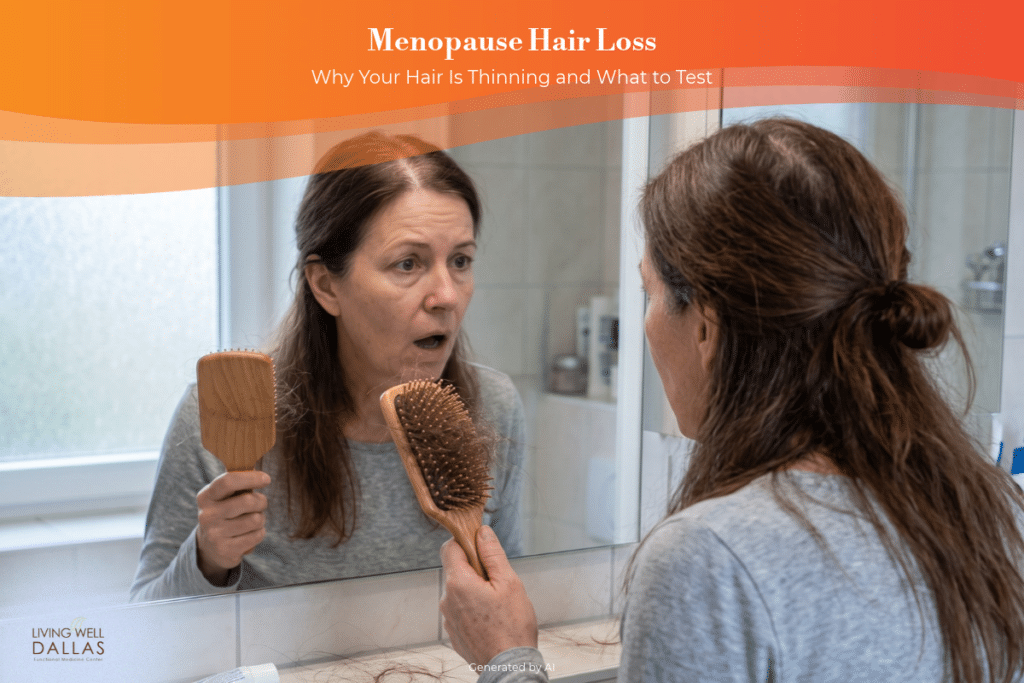
Let’s clear up the biggest myth first: menopause hair loss is not “just stress,” and it is not “just aging.” Those are the two answers women hear most often. Both shut the conversation down before anyone orders a single lab test.
Here’s the truth. Thinning hair in midlife rarely has one cause. Hormones shift, iron stores drain, and the thyroid slows, all in the same window of life. And conventional medicine usually checks none of those things in any depth. I see it in my practice every week: a woman holds up a ponytail half as thick as it was two years ago and asks, “Is this going to keep happening?”
So this post from Living Well Dallas Functional Medicine Center gives you what the standard visit leaves out. You will see what the research says, which labs to ask for, and which treatments earn a place in a real plan. Because hair is not a vanity issue. It is a visible signal that something inside your body is changing.
How Common Is Menopause Hair Loss?
Here is the number that surprised many of my patients. In a 2025 review in Maturitas, the authors reported that female pattern hair loss affected 52.2% of women (93 of 178) past menopause in one study they cited. In other words, that is more than one in two.
Translation: if your hair is thinning after 50, you are not imagining it, and you are in the majority. The American Academy of Dermatology calls female pattern hair loss “the most-common cause of hair loss in women”, and it typically starts in the 40s to 60s, right when perimenopause begins.
The pattern looks different from the male version. Because of that, most women do not go bald at the temples. Instead, your part widens, your ponytail shrinks, and the crown thins while the front hairline mostly holds. In other words, you lose density, not the whole head.
Normal Shedding Versus Real Thinning
Everyone sheds. In fact, most of us lose roughly 50 to 100 hairs a day, and that is normal. Real menopause hair loss shows up as a wider part, a thinner ponytail, or more hair in the brush and drain for three months or longer.
So here is a simple test I give patients. First, take a photo of your part in the same bright light once a month. Additionally, measure your ponytail circumference with a string. Because numbers beat memory every time, you will spot a trend by month three.
What Hormones Do to Your Hair During the Menopause Transition
Your hair follicles carry receptors for estrogen, progesterone, and androgens. As a result, every shift in those hormones changes how long each hair grows and how thick it stays.
The Maturitas authors describe the swing clearly. Estradiol falls to under 20 pg/mL after menopause, compared with 350 to 450 pg/mL mid-cycle. In other words, that is a drop of more than 94%. Estrogen helps keep hair in its growth phase, so a collapse like that shortens the phase and thins each strand.
The Androgen Shift
Estrogen also lowers the activity of androgens. So when estrogen drops, your androgens do not rise by much, but they matter far more because nothing balances them. Specifically, the review notes that lower estrogen reduces sex hormone binding globulin, which frees up more active androgen. DHT, a potent androgen, then blocks the Wnt/beta-catenin signal that follicles need to grow hair.
Here’s what that means: your follicles shrink a little with each cycle. As a result, a thick, pigmented hair becomes a finer, shorter one. After a few years, the scalp looks thinner even though you still have the same number of follicles.
Progesterone Falls First
Progesterone often drops years before estrogen does. That matters because progesterone may also dampen the enzyme that makes DHT from testosterone. In my practice, I see women in their early 40s with regular periods who already notice shedding. Specifically, their estradiol looks fine on paper. Their progesterone does not.
That said, the research on hormone therapy and hair is mixed. The same review states that hormone replacement has “shown limited efficacy when compared to standard treatments” for hair. So hormone therapy can help the overall picture, but I never promise a woman that it will regrow her hair on its own.
Menopause Hair Loss Is Rarely Just Hormones
This is where conventional medicine loses women. Your doctor checks your age, glances at your part, and says it’s hormonal. Meanwhile, nobody is connecting the dots between your hair and the rest of your lab work.
Three other drivers show up again and again in my practice: low iron stores, a sluggish thyroid, and chronic stress with poor sleep. Each one can push hair into the resting phase early. In fact, in perimenopause, all three often stack.
Iron and Ferritin: The Most Missed Lab
Ferritin is your iron storage protein. Because of that, your hair follicles are among the first tissues your body shortchanges when iron runs low. Meanwhile, heavy perimenopause periods drain iron fast.
A 2023 review in Cutis laid out the numbers. In one study it cited, women with telogen effluvium averaged a ferritin of 16.3 ng/mL, while women with no hair loss averaged 60.3 ng/mL. Translation: a ferritin of 30 ng/mL or lower carried 21 times the odds of telogen effluvium.
Here’s what that means: a woman with a ferritin of 22 ng/mL gets a lab report that says “normal.” But her hair follicles have already noticed.
Standard lab ranges often list anything above 12 or 15 ng/mL as acceptable. Instead, that cutoff exists to catch anemia, not to protect your hair. In my practice, I like to see ferritin well above 50 to 70 ng/mL for women with thinning. That target is my clinical practice guidance, not a result from the studies above.
Thyroid: Normal TSH, Thinning Hair
Thyroid hormone drives the speed of your hair cycle. When it runs low, hair thins evenly across the scalp, and the outer third of your eyebrows can fade too. In fact, hypothyroidism becomes more common as women move through perimenopause, and the symptoms overlap almost perfectly: fatigue, weight gain, dry skin, brain fog, and hair loss.
Most doctors run a TSH alone. In fact, a TSH between 0.5 and 4.5 mIU/L gets labeled normal. But free T3, free T4, and thyroid antibodies often tell a different story. I’ve seen women with a “normal” TSH of 3.8 and positive thyroid antibodies who felt terrible for years. So a full thyroid workup catches what a single number misses.
Stress, Sleep, and Cortisol
Severe stress, a poor night’s sleep that repeats for weeks, or crash dieting can trigger telogen effluvium. In other words, a large share of your hairs shift into the shedding phase at once. Specifically, the shedding shows up about three months after the trigger, which is why women rarely connect the two.
Perimenopause hands you plenty of triggers: night sweats, insomnia, anxiety, and unpredictable periods. Because of that, hair loss often arrives right on schedule, three months after the worst stretch of sleep you have had in years.
What to Test When Menopause Hair Loss Starts
You should not guess at hair loss. Instead, a good workup takes one blood draw and a careful history. Here is the panel I ask patients to bring to the conversation.
The Labs That Matter
- Ferritin and a full iron panel: serum iron, TIBC, and transferrin saturation, not just hemoglobin.
- Complete thyroid panel: TSH, free T3, free T4, plus TPO and thyroglobulin antibodies.
- Hormone panel: estradiol, progesterone, FSH, total and free testosterone, SHBG, and DHEA-S. The ratios tell you more than any single value.
- Vitamin D (25-hydroxy): low levels link to several hair loss types.
- Fasting insulin and A1c: insulin resistance raises androgen activity and is a hidden driver in many women.
- Vitamin B12 and zinc: both support the follicle and run low in women on certain medications or restrictive diets.
Additionally, tell your provider about every medication you take. Blood pressure drugs, antidepressants, birth control pills, and some cholesterol drugs can all cause shedding.
When to Look at the Scalp
That said, not all hair loss comes from hormones or labs. Patchy loss, redness, burning, or scaling needs a dermatologist’s eyes. The AAD warns that other common causes of hair loss in women “can look a lot like” female pattern hair loss, and each needs a different treatment. So rule out scarring conditions early, because they destroy follicles for good.
Menopause Hair Loss Treatment Options That Actually Work
Hair grows slowly, so every treatment needs patience. So plan on six months before you judge anything. Now let me walk through what has evidence behind it.
Minoxidil
Topical minoxidil is the only over-the-counter option, and the FDA has approved it at 2% and 5% strengths for women. Specifically, it works by extending the growth phase of each follicle. The AAD says women need 6 to 12 months of daily use to judge results.
Expect a shedding spike in the first 2 to 8 weeks. That feels terrible, but in fact it means old hairs are making room for new ones. Most women quit during this window, and that is the biggest reason minoxidil “fails.” Low-dose oral minoxidil also exists, and some dermatologists prescribe it, but it needs a doctor to monitor blood pressure and fluid retention.
Anti-Androgen Options
Additionally, spironolactone blocks androgen receptors and is a common prescription for women with pattern thinning. The Maturitas review also describes finasteride, which blocks the enzyme that makes DHT. In one prospective study it cited, after 24 weeks 22 of 40 patients reported significant improvement, 12 reported moderate improvement, and 6 reported none.
That said, these drugs are not right for every woman. Finasteride in particular carries pregnancy cautions for women who can still conceive. So these medications belong in a plan with a doctor who knows your full history.
Hormone Therapy and Bioidentical Hormones
Hormone therapy will not regrow a full head of hair, as the research shows. Still, restoring estradiol and progesterone can ease the other symptoms that feed shedding: poor sleep, night sweats, and mood swings. Additionally, in some women, balanced progesterone also helps shift the DHT picture.
Because of that, I personalize this based on your labs and symptoms. A woman with high DHEA-S needs a different plan than one with low ferritin and a sluggish thyroid.
Nutrition and Targeted Support
Because hair is built from protein, it matters what you eat. If you eat under 60 to 70 grams of protein a day, your body prioritizes your muscles and organs over your hair. In my practice, I aim for 25 to 30 grams of protein at each meal. That is guidance from my practice, not from a single study.
Additionally, iron-rich foods help, and so does pairing them with vitamin C. If your ferritin is low, though, food alone rarely rebuilds it quickly, and a targeted iron supplement under supervision does the job. Please do not take iron blindly. Too much iron causes harm of its own, so test first.
Strength, Sleep, and Gentle Scalp Care
Lifestyle will not replace treatment, but it sets the stage for it. Strength training twice a week improves insulin sensitivity, and better insulin control calms androgen activity. Likewise, seven hours of sleep gives your follicles the repair window they need.
Additionally, go easy on your hair. Skip tight ponytails, limit high-heat tools, and wash with a gentle shampoo. Hair that is already fragile breaks faster, so protecting what you have buys time while the real fixes work. In my practice, I tell women to expect small wins first, like less hair in the drain, before they see new growth.
Procedures and Devices
Platelet-rich plasma (PRP) injections and low-level laser caps are growing options. That said, the evidence is encouraging but still limited, and results vary from woman to woman. I see them as add-ons to a foundation of labs and medication, not replacements for it.
What This Looks Like in Practice
A composite example shows how this works. Picture a 49-year-old woman who comes in after eight months of heavy shedding. Her regular doctor, however, ran a TSH of 3.4 and a hemoglobin of 12.1 and called her labs normal. She also had irregular periods and sleep that broke at 3 a.m. every night.
Our workup showed a ferritin of 19 ng/mL, positive thyroid antibodies, low progesterone, and a fasting insulin of 14 uIU/mL. Nobody had checked any of those. As a result, we treated all four: iron repletion, thyroid support, progesterone, and a low-carb, high-protein eating plan. She started 5% minoxidil too.
In time, her shedding slowed at three months. Then, at eight months, her stylist noticed baby hairs along her part. This story is an illustrative composite, but I see this pattern in my practice every month.
Key Takeaways
- Female pattern hair loss affected 52.2% of women (93 of 178) past menopause in a study cited in a 2025 Maturitas review.
- Estradiol drops from 350 to 450 pg/mL mid-cycle to under 20 pg/mL after menopause, and that shifts the balance toward androgens that shrink follicles.
- A ferritin of 30 ng/mL or lower carried 21 times the odds of telogen effluvium in a study cited by Cutis, even when the lab report calls it normal.
- Ask for ferritin, a full thyroid panel with antibodies, sex hormones, DHEA-S, vitamin D, and fasting insulin before you accept “it’s just aging.”
- Minoxidil needs 6 to 12 months of daily use, and a shedding spike in weeks 2 to 8 is normal, so stay with it.
Frequently Asked Questions
Does menopause hair loss grow back? Often, yes, in part. So if iron, thyroid, or stress drives the shedding, hair usually returns within 6 to 12 months of fixing the cause. In contrast, pattern thinning from follicle shrinkage needs ongoing treatment, because it progresses without it.
When does hair loss start in perimenopause? Many women notice it in their early to mid 40s, years before their last period. Specifically, progesterone often falls first. As a result, shedding can start while your cycles still look regular.
Hormones and Labs
Can hormone therapy stop menopause hair loss? Not by itself. The 2025 Maturitas review found that hormone replacement showed limited efficacy for hair compared with standard treatments. That said, balanced hormones can improve sleep and stress, and both support healthier hair cycles.
What ferritin level do I need to stop hair thinning? So the lab range often starts at 12 to 15 ng/mL, but a ferritin of 30 ng/mL or lower carried 21 times the odds of telogen effluvium in one cited study. In my practice, I aim for 50 to 70 ng/mL. Additionally, I retest every 3 months while a woman replenishes her iron.
Treatment and Timeline
How long does minoxidil take to work? The AAD says to give it 6 to 12 months of daily use. Specifically, expect extra shedding during weeks 2 to 8. So take your monthly part photo and compare month 6 to month 0.
Should I see a dermatologist or a functional medicine doctor? Both can help. Specifically, a dermatologist rules out scarring or patchy conditions and prescribes hair-specific drugs. A functional medicine doctor looks at hormones, iron, thyroid, insulin, and sleep together. In fact, the best results come when the two work as a team.
Dr. Betty’s Bottom Line
Menopause hair loss is not vanity, and it is not “just aging.” Your follicles respond to estrogen, progesterone, androgens, iron, thyroid hormone, and stress. In midlife, all of them move at once. In fact, a single TSH and a quick glance at your part will not catch that.
So ask for the full workup. Fix the low ferritin, the thyroid that runs slow, and the hormones that dropped. Then add the treatments with proof behind them, and give them a full 6 to 12 months. Women deserve better than a shrug, and I will keep saying so.
In-person care at Living Well Dallas Functional Medicine Center is available for patients in the Dallas area, including a full hair loss workup covering ferritin, thyroid, sex hormones, DHEA-S, and insulin, followed by a personalized treatment plan.
Source: Gupta AK, Economopoulos V, Mann A, Wang T, Mirmirani P. Menopause and hair loss in women: Exploring the hormonal transition. Maturitas. 2025;198:108378. https://doi.org/10.1016/j.maturitas.2025.108378. Additional sources: American Academy of Dermatology, Female pattern hair loss; Cutis 2023, Serum Ferritin Levels: A Clinical Guide in Patients With Hair Loss.