
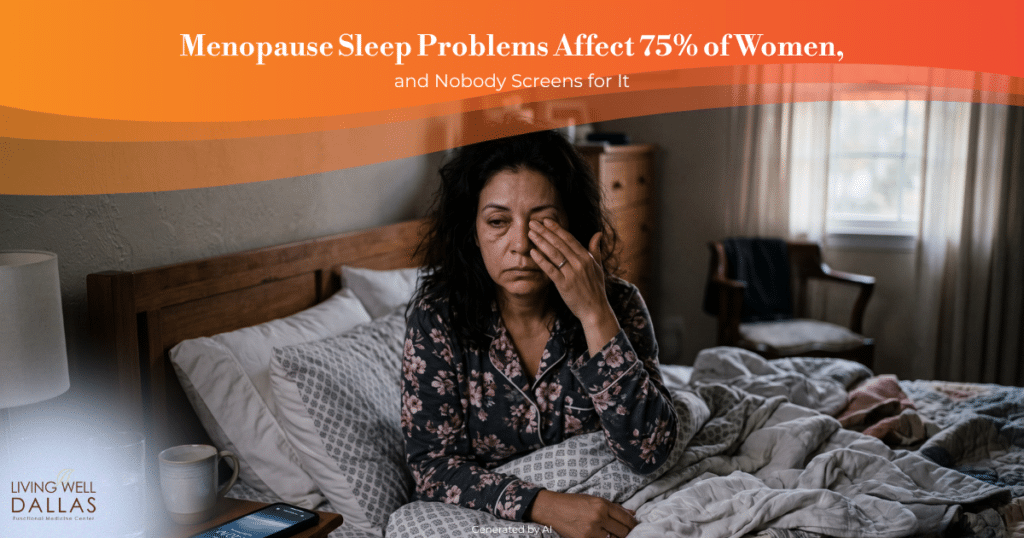
You’ve been told your sleep trouble is just stress, or age, or something to fix with a better bedtime routine. That is conventional medicine’s answer. It misses the actual driver sitting right in front of every doctor who runs a checkup during perimenopause.
Women come to me exhausted, running on four broken hours a night, and their annual exam never once asked about sleep. Nobody connected their 3 a.m. wake-ups to their changing hormones. Instead, they get told to cut caffeine and try melatonin, as if that solves a problem rooted in a shifting hormonal system.
A new national poll confirms what I hear in my practice nearly every day. And the gap between what women experience and what gets screened for is enormous.
What the New Poll Found on Menopause Sleep Problems
Researchers behind the National Poll on Healthy Aging presented new data in May 2026. The findings came from the American College of Obstetricians and Gynecologists Annual Clinical and Scientific Meeting, drawing on responses from 1,202 women ages 50 to 80 across the United States.
Here’s what they found: 75% of women with menopausal symptoms reported sleep problems, compared to just 49.8% of women without symptoms. Translation: hormonal symptoms and sleep disruption travel together far more often than routine care accounts for.
The researchers specifically recommended sleep screening as a standard part of menopause evaluation. That recommendation exists because right now, most doctors are not asking.
What This Looks Like in Practice
I see this gap constantly at Living Well Dallas. A woman describes waking at 2 or 3 a.m. every night, and her provider chalks it up to stress without ever asking whether her hot flashes are the actual trigger. Nobody tests her hormone levels. Nobody looks at her cortisol rhythm. She gets a sleep hygiene pamphlet and gets sent on her way.
Why Menopause Sleep Problems Go Deeper Than Bad Habits
Sleep disruption during perimenopause is not primarily a behavior problem. Estrogen and progesterone both influence the brain chemistry that regulates deep sleep. As those hormones fluctuate, sleep patterns change right along with them. Add hot flashes and night sweats into the mix, and interrupted sleep becomes almost guaranteed.
So when a woman tells her doctor she cannot stay asleep, the conversation should start with her hormones, not her caffeine habit. Because sleep hygiene advice, while useful, does nothing to address a hormonal system that is actively working against rest.
The Menopause Society has long recognized sleep disturbance as a core symptom of this transition, not a side effect to manage separately. Medicine has been slow to catch up to that recognition in everyday practice.
What This Means for You
If you have been losing sleep for months and nobody has asked about your cycle, hot flashes, or hormone levels, bring it up yourself. Ask specifically at your next appointment whether your sleep disruption could be tied to hormonal changes, not just stress or aging.
Treating insomnia without addressing estrogen and progesterone levels means treating the symptom while ignoring the cause.
Key Takeaways
- A May 2026 poll of 1,202 women found 75% with menopausal symptoms reported sleep problems, versus 49.8% without symptoms.
- Researchers specifically recommended sleep screening become a standard part of menopause evaluation.
- Estrogen and progesterone both influence deep sleep, so hormonal shifts directly disrupt sleep patterns.
- Hot flashes and night sweats compound the problem, making interrupted sleep the norm rather than the exception.
- Sleep hygiene advice alone will not fix a hormonal root cause, and it should not be the only recommendation you receive.
Frequently Asked Questions
Is poor sleep during menopause really connected to hormones, or is it just stress? Stress can worsen sleep, but this poll found a clear gap between symptomatic and non-symptomatic women. So hormonal changes appear to play a distinct role beyond general life stress.
Why doesn’t my doctor ask about my sleep during menopause visits? Sleep screening has not been a standard part of most menopause evaluations, which is exactly what this new research is pushing to change. You may need to raise the topic yourself until that becomes routine practice.
Symptoms and Screening Questions
What sleep symptoms should I mention to my doctor? Bring up difficulty falling asleep, frequent nighttime waking, night sweats, and feeling unrested despite a full night in bed. Each of these can point toward a hormonal driver rather than a behavioral one.
Can hormone therapy actually improve sleep quality? For many women, addressing the hormonal fluctuations behind night sweats and hot flashes improves sleep quality as a direct result. This is not automatically off the table just because your doctor defaulted to a sleep aid first.
Treatment and Next Step Questions
What should I ask for if sleep hygiene tips have not worked? Ask for a full hormone panel and a specific conversation about whether your hot flashes or night sweats are disrupting your sleep. A referral to a sleep specialist without this context often misses the underlying cause.
How long does it typically take to see improvement once the hormonal cause is addressed? Many women notice improved sleep within a few weeks of starting an appropriate treatment plan, though individual timelines vary. Consistent follow-up helps confirm the plan is actually working for your body.
Dr. Betty’s Bottom Line
I have sat across from too many exhausted women who were told their sleep trouble was just part of getting older. It is not. It is frequently a hormonal signal that conventional care has never learned to ask about.
This new poll gives us the numbers to back up what patients have told me for years about menopause sleep problems: sleep and hormones are not separate conversations. If you are running on empty and nobody has asked why, ask the question yourself. Your sleep deserves a real answer, not a pamphlet.
In-person care at Living Well Dallas is available for patients in the Dallas area, where sleep and hormone evaluation happen together as one conversation.
Source: National Poll on Healthy Aging. “Sleep Screening May Be Key in Menopause Care.” Presented at the American College of Obstetricians and Gynecologists Annual Clinical and Scientific Meeting, May 2026. https://www.patientcareonline.com/view/sleep-screening-may-be-key-in-menopause-care-national-poll-suggests